- 10 Most Clutch Plays in NBA Finals History | The Countdown
- Detroit Lions News & Rumors | Maxx Crosby Restructure So I Know Its Real | Sports Talk w/a Lions Fan
- Detroit Lions Fan Says “Get Off Tyler Linderbaum’s ****
- Viper Man At Bat | A Sorta Silent Film
- Which Heisman Winner Had the Best NFL Career? | The Countdown
- Top 10 Heisman Snubs in NCAA History
- Taylor Swift – Style – Qwanny’s Version | Q3 Media Super Bowl Ad
- 10 Greatest Wide Receivers that NEVER Won a Super Bowl
- 10 Best Christmas Day Performances in NBA History
- The Crush Podcast: Broncos Lose Again, Kelce the Clout Chaser
What’s Going On Started Singing It Not Knowing What It Was
- Updated: June 29, 2026

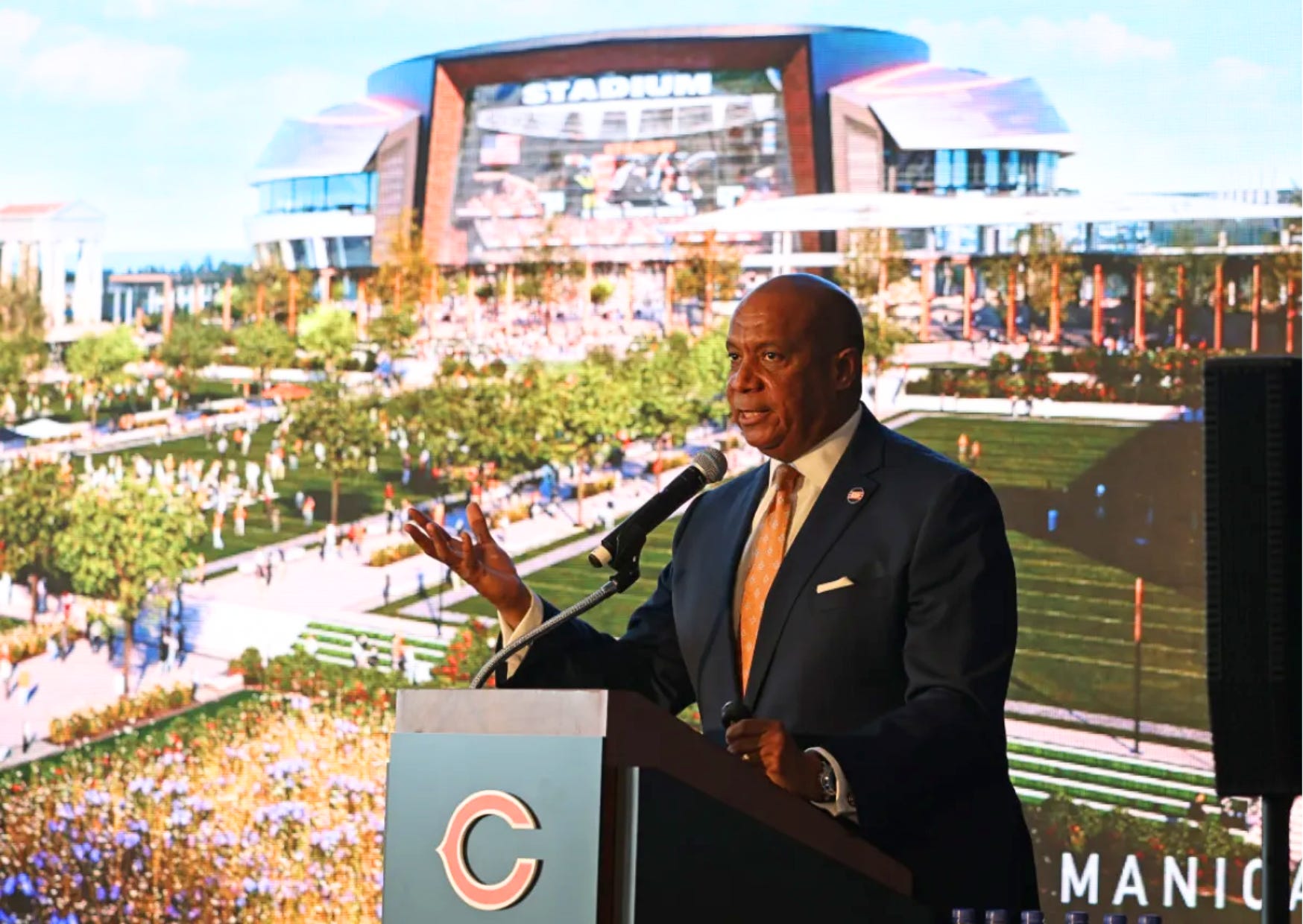
Yes, it goes on and on, my friend… [Photo: Brian Cassella, Chicago Tribune]
On June 5, the Bears announced that they were focused on Hammond, Indiana for their new stadium.
Statement from Chairman George H. McCaskey and President & CEO Kevin Warren: pic.twitter.com/U4lHzSV8Zv
— Chicago Bears (@ChicagoBears) June 5, 2026
This latest turn in the stadium saga was met largely with all the seriousness the fourth press release of the sort deserves. We’ll get into the Indiana idea in a moment, but first, it’s important to take a look at how we got here.
The Bears had been exploring the idea of a new stadium for years. Soldier Field is the smallest stadium in the NFL, it’s hard getting in and out of the stadium, the playing surface has been a running joke for years, and the stadium itself is very unimpressive by modern standards. The charter franchise of the NFL believes they should have a great stadium like the other teams building new palaces. Former Mayor Lori Lightfoot did not particularly seem to care about that and this is where the relationship between the team and the city began to sour.
The Arlington Park Racetrack property became available and the Bears saw an opportunity. In September 2021, the Bears reached an agreement to buy Arlington Park. In October of that year, Lightfoot threw major shade at the organization, saying that their focus should be putting a winning team on the field and finally beating the Packers. If the relationship wasn’t already dead at that point, that sure felt like the finishing blow. In July 2022, Lightfoot and her administration released renderings of what a renovated, domed Soldier Field coould look like, but that felt like it was far too little, far too late. The Arlington Park deal was finalized in February 2023 for $197.2 million, an amount that certainly looks like an overpay, but regardless, the Bears now had their focus.
2023 was an important year in Chicago, as it was a mayoral election year. Lightfoot failed to even advance to the runoff, where Brandon Johnson defeated Paul Vallas. While the focus for the Bears was still on Arlington Heights, a new mayor and new administration gave the city of Chicago at least a puncher’s chance of keeping the team in the city proper. Mayor Johnson (henceforth referred to as MBJ, to avoid any potential confusion with Coach Ben Johnson) was able to forge a much healthier relationship with the Bears than his predecessor did and in April 2024, the Bears and MBJ unveiled plans for a domed stadium on the lakefront. The stadium would have been publicly owned, but would have been paid for partially with public funding, which was ultimately a non-starter with the Illinois legislature, to say nothing of the challenges it would have faced from Friends of the Parks. (The success of any challenge from Friends of the Parks is questionable, but we never even got to that point.)
In May 2025, the team announced that the focus for the new stadium was on Arlington Heights. The Illinois legislature didn’t take up a bill to deal with the issue in either the spring or fall sessions in 2025 and in December, the team announced that it was widening the search for a location to include Northwest Indiana. The plan for Arlington is that the Bears would pay for the stadium itself, with the state contributing money to pay for necessary infrastructure upgrades. The large remaining issue is the property tax bill for the Arlington Park property. The property tax on a stadium in Arlington Heights would run approximately $53.2 million. The Bears want to lower that number and also lock in a rate so they know exactly what the costs will be going forward. The McCaskeys are not cash rich, at least by NFL owner standards – their net worth is tied to the team. Thus, they need to secure outside funding to build the stadium and in order to do that, they need to know what the exact costs will be. The proposed solution was a Payment In Lieu of Taxes, or PILOT. In 2026, a bill moved forward to deal with the Bears stadium and other potential future megaprojects. Under the proposed PILOT bill, the Bears would be able to negotiate a payment with local authorities that would take the place of the tax bill. The PILOT bill passed the Illinois House, but never even made it to a vote in the Senate. A Senate proposal passed after midnight on June 1 would allow cities in Cook County with a population over 70,000 to create their own stadium authorities, which would oversee the construction of a potential stadium, which the team would then “gift” to the city and the city would own. The Bears would still pay to build the stadium and collect most of the revenue from the stadium, exact amount subject to negotiation, but the city would own it, at least in name, thus avoiding the property tax issue altogether, as the Bears would be tenants, rather than owners. Many stadiums in the NFL operate this way. However, the legislature adjourned without the House ever even taking up the bill, with representatives citing the lateness of the proposal and a desire to actually read and discuss the bill before voting on it.
It is at this point that we need to pause and discuss the makeup of the Illinois state legislature. Currently, the 118-member House is made up of 78 Democrats and 40 Republicans, with 28 Democrats coming from Chicago.The 59-member Senate is made up of 40 Democrats and 19 Republicans, with 15 Democrats coming from Chicago. House Speaker Chris Welch has an unofficial rule that 60 Democrats must support a bill before it’s voted on. This is germane to our issue because 78 minus 28 is 50, meaning that a bill in the House needs at least some support from Chicago-based reps. This was something of a hangup for a while, as some Chicago-based reps were hesitant to support a bill that would help the Bears move their stadium to Arlington Heights, especially while the city still owes $356 million in debt taken on when they renovated Soldier Field in 2002. The Bears have paid off their share of the project and while there is nothing legally preventing them from telling the city of Chicago “not our problem,” it’s fair to note that the city took on that debt with the expectation that the Bears would be playing there and trying to tell the city to go pound sand would not ingratiate the team with representatives from the city whose votes they need. There are valid criticisms to be made of former Team President Ted Phillips, but he knew how to navigate the political landscape, a skill that has thus far eluded Kevin Warren.
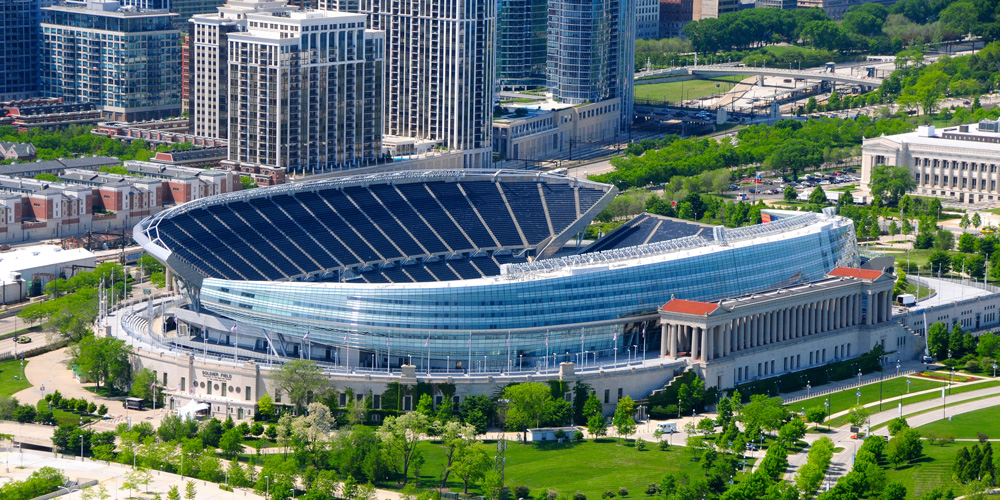
Still not paid off. [Photo: Illinois Sports Facilities Authority]
While the idea of building the stadium in Northwest Indiana had been floated previously, in December 2025, the team announced that they were going to seriously examine the idea of building across state lines. Indiana State Representative Earl Harris had been trying to make the idea of a major pro sports team in Northwest Indiana a reality for a while and now, he and other state lawmakers were going to get the chance. In February 2026, the state passed a bill to create the stadium authority that would oversee the project. Region municipalities began pitching ideas to the team. Gary and Mayor Eddie Melton proposed three different sites within the city. Portage and Mayor Austin Bonta proposed Halas Harbor, offering the team the chance to build not just the stadium, but a whole district in Portage. Ultimately, the team explored none of those options, at least not seriously, and focused on Hammond as their target in Northwest Indiana, identifying a space near Wolf Lake and Lost Marsh Golf Course as the potential future home of the stadium. Where, exactly, would the stadium go? I don’t know and neither does anyone else. At first, an area by Wolf Lake itself was the target, but that’s home to a giant slag heap and may require extensive cleanup in order to build there. The idea of a space just south of the golf course has been bandied about, but that would require other businesses and properties to be bought out first. The golf course itself could be the target, but NBC5’s Paris Schutz notes that due to protected status of the lake on the property, the Bears wouldn’t have as much space to build there as previously thought. While the stadium itself could likely be built there, there probably wouldn’t be room for any additional development. That’s of note because every time the Bears talk about their plans for Arlington Heights, the phrase “mixed use district” comes up. The Wolf Lake Terminals were reported as a target, but here’s Paris again…
According to Indiana state and federal records – the north part of that site is federally protected from any development, the south part is owned by the US Dept of Defense, and in between are a bunch of private businesses including oil tanks. The state would be looking at a… https://t.co/C69KwxTLG8 pic.twitter.com/AHlP0lAJGz
— Paris Schutz (@paschutz) June 28, 2026
Piecing these plans together – It appears the Bears are looking at some combination of Lost Marsh GC plus Wolf Lake terminals as a stadium + mega development site (neither site has enough buildable land on its own) – but there’s an Interstate running between them … https://t.co/LCwcJrRHsy
— Paris Schutz (@paschutz) June 28, 2026
The NWI Times report even includes a quote from Bears Senior VP of Public and Governmental Affairs Scott Hagel talking about a mixed-use development. This whole saga begins to make much more sense once one realizes that much like Ray Kroc wasn’t in the burger business, he was in the real estate business, the Bears aren’t so much looking for a stadium deal as they are looking for a real estate deal. It’s the ability to develop the area around a new stadium that’s really important here. The restaurants, hotels, what-have-you that would go up provide a year-round revenue stream. It’s the reason Tom Ricketts has spent so much money buying properties around Wrigley Field, often to the chagrin of the Cubs’ faithful, who don’t want to go a century between championships again and wish that money would instead be spent on the field. It also makes more sense once it’s put in the context of George being the last McCaskey who cares about owning the team. After he’s gone, the grandkids are going to cash in their chips, so not owning the stadium itself isn’t a big deal. Owning businesses around the stadium is the exciting prospect.
In addition to the issue of the possible cleanup necessities and environmental concerns in Hammond, there’s also the matter of paying for the stadium in Northwest Indiana. The state legislature created the authority that would oversee the development of the stadium and would issue bonds to pay for it. Those bonds would be paid off by creating a new taxing district in Hammond around the stadium, imposing a 12% admissions tax on events at the stadium, doubling the Lake County hotel tax from 5 to 10 percent, and imposing a 1% food and beverage tax in Lake and Porter Counties. The necessary infrastructure improvements would be funded with money acquired by renegotiating the lease of the Indiana Toll Road. That last bit is likely to ruffle some feathers downstate, where the state of Indiana still owes over half a billion dollars on Lucas Oil Stadium. State money being spent on anything to do with a new stadium a 9-iron from the state line that will compete with a stadium you still owe the GDP of a small island nation on to host events is really not the most fiscally intelligent plan. Furthermore, the food and beverage tax has irked some in Porter County who feel they shouldn’t be taxed to pay for a stadium that’s not going to benefit them. And they’re right! Nobody is flying into Chicago for a Bears game in Hammond and then popping over to Valparaiso for dinner. Chicagoans going to a game are not saying “let me see what culinary options Chesterton has to offer.” The hotel, restaurant, what-have-you dollars related to events at a potential stadium in Hammond are very likely to end up in Chicago. The Horseshoe Casino may see some extra money come in. The rest of The Region – not so much.
Regardless of the issues on the Indiana side of things, though, the fact that the team’s most recent press release on the matter put the Hoosier State nominally ahead has generated a plethora of finger-pointing on the Illinois side of the matter. Plenty of ire has been directed at J.B. Pritzker, but the competing interests within his state aren’t his fault. Pritzker’s in a difficult position because if the stadium gets built in Indiana, then the team left the state on his watch. Conversely, if he handed out a deal as irresponsible as the one Indiana did, he’d get skewered for that, and rightly so. While Pritzker’s political ambitions likely weigh on his decision making – he’s believed to be eyeing a White House run in 2028 – his priority has to be the people of Illinois, not a multi-billion-dollar company, and he’s got to make the right decisions for Illinoisans. So far, he has. Studies have repeatedly shown that public money for stadiums is a bad investment. This is not to say “don’t make a deal at all,” it’s to say that any deal made needs to, first and foremost, make sense for the taxpayers.
Fingers have also been pointed at MBJ, but those are even more ridiculous. MBJ wasn’t mayor when the Bears bought Arlington Park. He did, however, stand with them at the press conference the team held when they announced they were looking to build on the lakefront. When that fell through, it was because of Friends of the Parks, not MBJ. The mayor took some heat, including from Pritzker, when he went down to Springfield to lobby lawmakers to keep the team in Chicago. While one can say he was running the risk of screwing things up for the entire state, he can only be blamed so much, as the team was still talking with the city about building there. The team denied it, saying they only called to talk about the Soldier Field lease, but MBJ and State Senator Bill Cunningham both said that no, in fact, Chicago was not out of the running for the stadium per conversations with the team, and a FOIA request showed the team had called the city six times in April. Of course, as Pritzker noted in his frustrations with MBJ, there’s no clear site in Chicago. The Michael Reese hospital site was deemed unworkable and the problems that led to the collapse of the 2024 lakefront plan still exist. State Representative Curtis Tarver has proposed the former South Works site as a potential location and there’s enough land there for the Bears to develop beyond the stadium. Your author believes there’s a non-zero chance of this happening, as a stadium in Chicago would get more support from Chicago-based legislators and the project would be great for an area in need of development. However, this isn’t the first time the former South Works site has been bandied about, and MBJ himself noted that the only site in the city the team has looked at has been the lakefront.
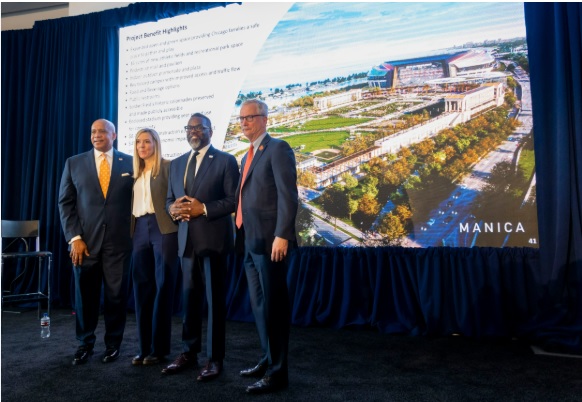
The Chicago plan [Photo: Brian Cassella, Chicago Tribune]
Also in Illinois, the village of McCook has entered the chat, proposing a former quarry site and multiple options to make ownership of the land and stadium work. While there’s less than half as much land available there than there is in Arlington Heights, the infrastructure is already there and it’s close enough to the city proper that it may win over legislators from the city who might not be overly enthused about the team building in Arlington Heights. It’s the politics of it all that’s held this project up and Kevin Warren’s lack of political savvy in regards to the matter is why the blame for the lack of celerity should be directed primarily at him. Warren clearly lacks a proper understanding of the political landscape. His statement praising Indiana after the state passed the bill to create a stadium authority ticked off Illinois lawmakers, who at that point, believed they were making progress, damaging what was already a somewhat tenuous relationship. Furthermore, Paris Schutz reported that Warren didn’t even listen to lobbyists that the team hired to assist in the matter. If you still don’t think the lion’s share, or in this case, the Bear’s share as it were, of the blame belongs on the shoulders of Kevin Warren, note that a new stadium for Northwestern football (funded by a minority owner of the Bears no less), a new stadium for the Chicago Fire, and the 1901 Project around the United Center are all underway. While it’s true that none of those are an apples-to-apples comparison with the Bears stadium project, it shows that Illinois is not the enemy of business that some want to claim it is.
So where do we go from here? Talks continue in Illinois. If a deal can be struck, a special session could be called to vote on a bill. Warren learned his lesson after his February statement miffed Illinois lawmakers and was much less strong in his wording this time around. In addition, before releasing the statement, the team reportedly called State Rep. Kam Buckner, one of the leaders in the Illinois legislature on the matter, and told him that talks would continue. The downside to this, of course, is that it made it pretty clear that the threat of building the stadium in Indiana is still a leverage play. The state of Indiana, at this point, should really see that they’re being used, but they can’t really do anything about that since their leverage here lies somewhere between zilch and bupkis. This isn’t to say that there’s zero chance the stadium ultimately gets built in Hammond – there is an actual chance it happens. However, the state of Indiana offered the Bears the moon, the sun, and the stars, and not only did the Bears not jump at it, they’re still talking with Illinois lawmakers after the legislature adjourned without a stadium bill done. And, really, that tells you everything you need to know here. If the Bears wanted to be in Indiana, they would by now. If Illinois lawmakers thought the Bears actually wanted to build in Indiana, they would be moving faster. Everybody is treating this latest statement by the team as a bluff, except for Indiana politicians, for obvious reasons, and Arlington Heights mayor Jim Tinaglia, for reasons that aren’t clear at all. Moreover, every attempt at making Indiana look like it’s not a bluff has been so poor that it just makes it look more like a bluff. And so, here we are, in the midst of a saga that makes the Jeopardy! host search look like a well-run process. Maybe Warren can take a page out of their book and split the stadium location – build it on the state line. (This is a joke, Kevin. Do not actually try this.) But just as the Jeopardy! saga ended with them hiring the guy they should’ve hired all along, Ken Jennings, your author believes this saga ends with the stadium where the Bears wanted it all along, Arlington Heights.